Monday, 22 November 2021

“Bewilderment" by Richard Powers - review


 “Bewilderment“ by Richard Powers:

“Dad! Everything is going backwards.“ 

This frustrated outcry of a nine-year-old to his father is the summary of my emotional revelation after reading this book. Defeated by the stupidity of half of mankind all goes down. The ship is sinking. 


Theo Byrne is an astrobiologist who programs simulations of life on extrasolar planets in order for these simulations later to be used in scientific programs in search of life on other planets in the universe. One major part of his life is devoted to the amazement and bewilderment in the face of life’s stunning stubbornness to spring up in the most unexpected places and the beauty of it all. 


The by far bigger part of his life is devoted to loving and taking care of his nine-year old son Robin who, an intelligent, sensitive, endearing, warm and kind boy with capricious moods and predilections, not only struggles with the demands of everyday life and social interaction but also with coming to terms with the loss of his mother, who died 2 years ago in a car crash. The love between son and father has an emotional truth and vividness that wrings the heart.


Caused by one of Robin’s violent outbreaks the family’s equilibrium is threatened by the school authorities’ demand to put robin on psychoactive drug medication. In search for a better solution Theo turns to a befriended neuroscientist and enrolls Robin in a program of experimental neuro-feedback treatment. The recorded neurological state of mind which Robin is given as a model to learn and profit from is that of his deceased mother, Alys.


Robin’s situation improves tremendously and with the same zeal as his mother before she died, he actively engages in the preservation and protection of endangered species. This is when the story leaves the safe microcosmos of family and leads to frustrating and lastly devastating contact with the outer world of insurmountable obstacles, ruled by a political system driven by greed and economy and the unwillingness of people to face the truth. Son and father in the end loose all. 


“Oh, this planet was a good one. And we, too, were good, as good as the burn of the sun and the rain’s sting and the smell of living soil, the all-over song of endless solutions signing the air of a changing world that by every calculation ought never to have been.“


This is indeed a very emotional tale, sad in the end, but also full of hope and wonder at life itself, the beauty and immensity of it all and the tiny hope that someday something somewhere survives and thrives.


#robertfaeth, #painterinBerlin, #painting, #art, #bookblog, #bookreviews, #literaturelover, #poem, #poetry

Monday, 15 November 2021

“WILLNOT" by James Sallis - review


 “Willnot” by James Sallis:

“Fish die belly upward and rise to the surface. It’s their way of falling.”


This quote by AndrĂ© Gide might serve to describe this moment of realization, when reality isn’t quite what it used to be the moment before, when unnoticed, a rupture tore through its fabric and something isn’t quite right, something has shifted.


WILLNOT starts in the form of a suspense novel with four bodies found in a pit. We soon learn, though that this is not a suspense novel, it doesn’t follow the rules of one. What it is defies easy classification, it is genre bending.

There is no hunt, there is no whodunnit and after a while the four bodies get lost in oblivion, like rocks being thrown into a pond, mud swirled at first and then slowly settled. 

WILLNOT is an interesting puzzle. It leaves several questions unanswered by the end and surprisingly this is not frustrating or disappointing.

WILLNOT is a crime story only in pretense where in fact it is a wonderful reflective narrative about the dramas that play out in an American small town, a subtle look on many aspects of small-town life seen through the eyes of Lamar Hale, the local physician and surgeon, who has the gift to follow the souls of people into their past. 


“Life has to be lived in a forward motion but can only be understood retrospectively. “This quote from Kierkegaard illuminates the dilemma of Lamar Hale. He is caught between the future and the past, almost like a time traveler who is caught in an infinity-loop and this (and his profession) makes him a silent, attentive observer of the boundaries between life and death.  


Lamar is a decent doctor, thoughtful and compassionate, who lives together with his romantic partner Richard, a teacher, in quiet domestic circumstances while around them chaos in form of the town life, colleagues, patients, friends, acquaintances, a cast of memorable characters, revolves. It is a complex and nuanced environment, by terms world-weary and life-affirming. Lamar feels and makes us feel that there is a layer of a world beneath the surface, beneath appearance. 


The prose is reduced, nevertheless poignant and vivid with a shimmering rustic poetry and captures well the way people think, speak and interact. The tone often is noir-ish, snappy, sharp, laconic and interspersed with philosophical oberservations. Wittgenstein, Kierkegaard and Adorno are mentioned, there are existential musings on life, illness, impotence and death.


Why are we reading? One answer to this is that in reading we get a sense of the lives we can’t or won’t have. 

WILLNOT is a book that gives us this sense. 


#robertfaeth, #painterinBerlin, #painting, #art, #bookblog, #bookreviews, #literaturelover, #poem, #poetry

Wednesday, 10 November 2021

"Crossroads" by Jonathan Franzen - review


“Crossroads“ by Jonathan Franzen:


In this excellent not to say, marvelous novel, a pleasure to read, Franzen stays true to his previous themes: the quietly disintegrating household which lives in stiflingly strained, existential distress and the dramas that are played out again and again in each new generation. Franzen paints a cast of warm vivid characters who reside in the respectable township of New Prospect, a city outside Chicago, Illinois. It is the year 1971 and on a single winter day shortly before Christmas, in a play of interwoven perspectives, the story unfolds. 


Here in New Prospect lives the family Hildebrandt, the parents, three sons, one daughter. The Hildebrandts are all isolated in self-absorbed worlds and terrified of their own irrelevance, they are lost and lonely, picking their way through the dark and often are a mystery even to themselves. Each one of them implicitly knows that punishment will be their fate for straying and sinning. Each one struggles “to be good” while strategizing what advantages this being-good could gain them. 


There is Russ, the household patriarch, the associate minister of the parsonage. The pastor, a man who for facades sake plays virtuous but inwardly is self-pitying, who is in principle progressive but in practice reactionary. Empathy is not his strength, either and he can’t help feeling that he is a man of yesterday, that he’s lost “the edge” and that the future belongs to, in his opinion, frauds such as handsome and charismatic Rick Ambrose, the pastor who succeeded in winning over from him the adolescent members of the church’s youth group Crossroads. Ever since that incident, after being humiliatingly ousted from the group, Russ spends his days hating him, which flavors everything about his job.

Russ’s relationship with his wife is, to say the least, difficult. The rift in their marriage becomes openly clear when Russ becomes infatuated with a young widowed member of his congregation and his wife moves out of their bedroom. Because he is in the business of penitence, Russ recognizes the certainty that he is a sinner, but then he is also so very holier-than-though that he finds a way to gain even out of his moral decay. Shame and self-debasement are his portals to God’s mercy.


There is Marion who, as her husband, stands at a personal and spiritual crossroads. She is a frustrated, overweight housewife, depressive and full of resentments, as tragicomic as these characters tend to be, her womanhood, her personality rendered invisible to her family behind a cloud of momminess. 

Educated as a Catholic she married her missionary Protestant husband and still knows the distinct Catholic feeling of guilt which to her is the inescapable consequence of sin. The arrival of Christmas, the images of red-clad Santas in the stores, sparks memories of a disastrous love affair in Los Angeles 30 years ago. In a scene between Marion and her psychiatrist she is transported back to her early 20s, where she had this toxic affair that landed her in a mental hospital, and now as her marriage splinters many of her then most extreme behaviors return. 

Marion is one of the most vividly painted characters and might well be the most memorable of the Hildebrandts. 


There is 15-year-old Perry, the Hildebrandts’ precocious third child, the real catastrophe of the novel. Blessed with an IQ of 160 and cursed with a growing drug addiction, he plunges more and more into the dark. Only shortly is Perry able to abdicate from drugs by participating in Crossroads, the youth group in which a “public display of emotion purchased overwhelming approval.” He muses that “Goodness is an inverse function of intelligence.”: “Even if you bring in God, and make Him the measure of goodness, the person who worships and obeys Him still wants something for himself. He enjoys the feeling of being righteous, or he wants eternal life.”

Some of the finest passages in Crossroads evoke Perry’s brightly burning intelligent mind in intensifying need of narcotics and quest for oblivion.


There is 18-year-old Becky, the only daughter, the pretty social high-school queen and cheerleader type. She joins the youth group Crossroads and thus deals her father a heavy blow of betrayal. Becky is not a member of her father’s church, and regards him and his faith skeptically. Becky has fallen in love for the first time and the object of her desire is a handsome churchgoing musician. Suddenly she realizes that “if she opened herself to the possibility of belief she might gain an unforeseen advantage.” A marijuana-induced encounter with God brings her closer to her boyfriend and farther from her family.


There is Clem, the eldest son, a student, who also struggles to retain control over his own life. While he and his sister Becky form a loving sibling relationship he is in difficult rivalry with his father. Clem is an atheist and moral absolutist, his solution to be good is that he needs to be and do the opposite of whatever his father, whom he considers to be a moral fraud, is or would do. Clem is coming home from college with a resolution that will shatter his father. In a bravura act of dichotomy, in a very intense setting he, while having intercourse, breaks up with his girlfriend who loves him in an “old-fashioned, romantic, totalizing way” and returns home for Christmas.


There is 9-year-old Judson, the youngest son, whom everyone likes but who doesn’t get as much attention in the book as the other members of the household. 


And finally there is the youth group Crossroads, with its tribal air and climate of performative truth-telling, its theatrical spirituality of trying to see God in the relationship between human beings. It seems like a harbinger of our modern social media world, “Love” is everywhere but empathy is hard to find, hugs are freely given but real connections are harder to come by. 


Crossroads breathes and evokes the air of the 70s quite well in its emotional dishevelment which strangely finds its similarity in our times. There is the same feeling of urgent expectancy. Sometimes it’s easy to forget that these are the 70s were it not for the absence of television and internet. The novel lives on the friction between conservatism and radicalism, Christianity and social activism, and hints that there might not be a solution, that life is full of hardship and that families are both an importancy and utterly, impossibly disastrous. 


All of the characters may seem small, manageable and unimportant but the inner lives of them are boundless. And it is exactly this quality, that in smallness such impressive humanity is hidden, that lends the novel greatness.

At first, Crossroads seems like a return to form. As in previous novels Franzen uses family drama to gesture at a global crisis. But thematically and in tone the novel proceeds and evolves beyond previous works. 


This is a novel about how to be a good person, a novel with a strong religious and moral presence. In this it is in the tradition of the 19th-century novel. Many of the philosophical questions have their origin in the moral philosophy of the German Idealism and are raised without cynicism or irony but in heartfelt seriousness. 

Franzen’s ambition seems to lie not only in mirroring society, but to return the individual readers to themselves by inviting them to find out how to answer and position themselves in regard to these questions. In taking an interest in the character’s trials and tribulations one finds it impossible not to be engaged by the most momentous questions of faith and morale - quite a Dostoyevskian move. 


 - If I do something good and selfless but at the same time do it also for personal reasons is it then truly good?

 - How can I proof to God and myself that my motives are pure?

 - Can a deed be bad if the intention was a good one?


Since there is no internet and hardly any TV, these questions appear pristine and unspoiled by irony, untouched by pop-culture, as if they have never been uttered or been trivialized before in countless soaps which make up our modern-day catalogue of narratives. This gives them a refreshing newness and sincerity. This is a world inhabited by people who seem like us but are an eternity of media evolution apart.


The writing is a marvel, it is brilliant and absorbing and throughout the book one has the safe feeling of being in the hands of a very confident storyteller and gratefully lets oneself being immersed and propelled forward in the story. This is family drama as high art. The illuminating of the inner lives of the characters is masterful. One of the most attractive aspects of Crossroads is its depth of moral and religious contemplation. It also shows that literature can still function as a vehicle to explore humanity’s most existential concepts. 


#robertfaeth, #painterinBerlin, #painting, #art, #bookblog, #bookreviews, #literaturelover, #poem, #poetry

Sunday, 31 October 2021

“Lust, Caution" by Eileen Chanag - review (sort of)


“Lust, Caution" by Eileen Chang:

In the midst of the Japanese occupation of China and Hong Kong two people meet, for very different reasons, Wong Chia Chi, a young student active in the resistance, and Mr. Yee, a powerful political figure who works for the Japanese occupational government.


Wong Chia Chi earlier in her life fell in love with the theater, so that now, at the cost of her own life, she acts out in reality her stage role in a treacherous spy ring of wartime Shanghai. Chia Chi spends her days mixing with high-societal ladies who spend most of their time discussing jewelery and mah-jong. Occasionally she meets Mr. Yee for romantic reasons. Her real aim, her task, though is to lure Mr. Yee to a place where he can be assassinated. At the last moment she changes her mind, warns him and saves his life only to loose hers in the end.


While the prose is easy without being overly poetic I never really cared for any of the characters, no emotions were kindled nor any resonance evoked. There were far too many characters in this short novella and even while writing this review, I’m struggling to remember their names.


The plot, as an idea, is a good one but the handywork leaves much to be wished for. There is no suspense, no drive, the whole thing is quite boring to read. Suspicion about the publication sets in, all the pretty word hype accompanying the publishing of this novella seem now, after having read the book, just that: empty words meant to promote the book after the movie by Ang Lee, which is based on the story, was met with approval and success. 


I was not gripped.


I do understand, though how Ang Lee the film director, could make a good movie out of this foundation. There is much to find, fill out and explore in the concept, in the idea of the story. The novella did not exploit these possibilities and thus made only a meager construct. Luckily it was a very short novella.


#robertfaeth, #painterinBerlin, #painting, #art, #bookblog, #bookreviews, #literaturelover, #poem, #poetry


Sunday, 24 October 2021

"Doktor Faustus" by Thomas Mann - review


 “Doktor Faustus” by Thomas Mann:

This is, among so many other things, a fictional biography of the composer Adrian LeverkĂ¼hn, who devotes himself to the devil. It is a well-educated, wonderfully composed, profound and tragic tale.


In following all the stages of development of the old Faust saga Thomas Mann links them with the threats and problems of our (that) time, the turn of a highly and overdeveloped national spirit to archaic primitivity and cruelty, resulting in awful disaster. The time frame are the years from 1884 to 1945, roughly Thomas Mann’s period. The book is Thomas Mann’s last great novel and was first published in 1947. The original title at first publication was „Doktor Faustus - Das Leben des deutschen Tonsetzers Adrian LeverkĂ¼hn“ - erzählt von einem Freunde”. (“Doktor Faustus - The Life Of The German Composer Adrian LeverkĂ¼hn As Told By A Friend”). 


The work is suffused with Mann's moral despair over his country's complacent embrace of Nazism and can be read as an allegory of how it came to be and how it came into being that Germany sold its humanity and soul. 


Thomas Mann himself called his novel a book of life of almost criminal ruthlessness, a strange kind of transferred autobiography, a work that “cost me more and consumed me more than any previous one." This feeling, that this was something which really had his greatest interest, energy and sympathy, is noticeable throughout the book.


I bow my head in awe and humility to this book. It took me a long time to read it, not in actual hours but in the time to be right for me to want to read, to finally read, understand, reflect and lastly highly appreciate it. This book shows what literature is capable of, what heights can be reached and what achievements can be made, what literature as an art form should strive for. 


All is told by the third person narrator Serenus Zeitblom, the dear humanist friend and companion of the composer Adrian LeverkĂ¼hn from childhood on. 


Through this friend, through reflective distance we get to know Adrian LeverkĂ¼hn, a clever, aloft, proud spirit, isolated, brilliant, overreaching, someone who is too clever for almost any profession, the work of a composer included. LeverkĂ¼hn is filled with the artistic urge for creating -  without any inhibitions, without any regards to tradition or history, ruthlessly. He is a radical in the utmost sense. LeverkĂ¼hn, in a Faustian pact bargains, after having, almost willingly contracted syphilis, his soul and the possibility to love for achievement of 24 years of unparalleled grandiose musical accomplishment.


There could be noticed, if so wanted, an allusion to the fascist intoxication which befell the peoples on the political level of the book. Apart from the political, though, many other levels permeate this book:

There is the ostensible re-telling of an old, typical German myth. 

There is the aspect of the KĂ¼nstlerroman which lets us follow the life of the artist. 

There is the aspect of a social novel, there is life, there is art, there is philosophy, theology, musicology. 

There is a very extraordinary attempt to approach and describe music, in Mann’s opinion the most typical German of all art forms, with the means of prose and poetry and expose its role in society. Throughout the book there are enlightening passages which read like theoretical essays on art. 

There is indeed so much in this book, not least very much wisdom, that I find it impossible to give name to it all. It is also Mann's profound meditation on the German genius - a genius torn between profundity and form, both on the national and individual level.


The prose is absolute magical mastery, a highly intelligent, exquisitely fine-tuned machinery of words, beauty and the German language. Mann's known mastery in sentence structure is one thing but here he sometimes drives his linguistic finesse to the point of self-parody which gives the text additional charm. More than once I had moments of benign bliss that made me proud and happy to be capable to truly appreciate German. (I hear there are good translations, nevertheless). 


Impressive, frightening the moment when the Devil first makes its appearance, even seen through the reflections of an intellectually well-educated mind formed by the 20th century. Mann plays with virtuosity the psychology, the archetypical fear, the existential inferiority, the wavering metaphysic and conveys with bravura the feeling of being at the mercy of something fatefully inescapable, of doom.


Mann had the talent to assemble grandiose themes, knowledge, education and drama and fabricate out of them a wonderfully light-footed text, always entertaining, never becoming a boring show-off of style. A great book, a timeless classic, maybe one of the last few.


#robertfaeth, #painterinBerlin, #painting, #art, #bookblog, #bookreviews, #literaturelover, #poem, #poetry

Tuesday, 12 October 2021

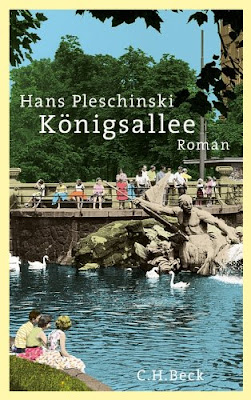
"Königsallee" by Hans Pleschinski - review


 “Königsallee“ by Hans Pleschinski:

It is the summer of 1954 and Thomas Mann, Nobel laureate, 80 years old, out from his exile in Switzerland, ZĂ¼rich, pays DĂ¼sseldorf a visit, together with his wife Katia and his daughter Erika. He intends a reading of his new novel “Felix Krull“  which is developing into a bestseller. 


It is sheer chance that at the same time Klaus Heuser stays in the same hotel, together with his lover Anwar. Heuser is shortly back from his own exile in Indonesia to visit his aging parents. 


Thomas Mann met Klaus Heuser back in 1927 at a beach on Sylt in Germany where he stayed for a holiday with his family and fell in love with the young man. He invited him to stay at his house in Munich and Heuser, who then was a handsome young man and beguiled many with his sweet looks and charms, became one of the great loves of Thomas Mann and served as model for the character in Mann’s Joseph novels. 


Although they stayed in loose contact and wrote letters to each other, neither Mann nor Heuser know the other is staying at the same hotel. And the escort of Thomas Mann, namely Erika and Katia Mann, want to prevent a meeting of them at all costs for fear of unforeseen complications. Mann’s politically difficult visit in DĂ¼sseldorf and post-war Germany is already stress enough and the great magician's equilibrium shall not be disturbed further.


Out of this scenario, based on real events and research of manuscripts and journals, Pleschinski spins an atmospheric lively tale full of remarkable figures and encounters. We meet cameos of Erika Mann, the daughter, of Katia Mann, the wife, of Golo Mann, the son, of Ernst Bertram, former writer, poet, professor in the service of Nazi Germany. They all have their own agenda to follow and so do the dignitaries of the city of DĂ¼sseldorf. 


The prose mirrors the times but also the depth and profundity the German language is capable of, a language which seems to be the only one possible to really be able to transport that which is so delightfully good in the German soul and at the same time so frighteningly bad. 


It is not only a novel about an unlikely encounter between two former lovers, it is also a novel about life, about literature, about fame and abdication. It is about the responsibility of the artist and the prize one has to pay for life, for success or fame. 


It is also a novel about the 50s in Germany. A very remarkable area, not necessarily a proud and acceptable one, saturated, soaked with falsehood, prudery, and a maybe, typical German righteousness and unwillingness to admit guilt and wrongdoing.


I thoroughly enjoyed this book, for its surprising plot, for its lively, often humorous rendering of famous figures and its playfully great mastery of the German language.


#robertfaeth, #painterinBerlin, #painting, #art, #bookblog, #bookreviews, #literaturelover, #poem, #poetry

Saturday, 9 October 2021

"Filthy Animals" by Brandon Taylor - review


 “Filthy Animals” by Brandon Taylor:

This collection of loosely linked short stories highlights momentary dramas of loosely connected young people. 


As in Normal People by Sally Rooney, these members of the younger/youngest generation act and live, connect and disconnect with a frightening speed under rules both bafflling and eluding immediate understanding. Maybe there are no rules at all. The lives of these people unfold for a short moment in sometimes banal, sometimes harsh and unforgiving, unsentimental or frightening ways and show them at their most vulnerable.


Underlying all these stories and glimpses of lives is a melancholy that stretches far beyond the normal lost feeling of coming-of-age. It is a melancholy that comes from being lonely. All these people are lonely, even in closest contact to each other or being in company. There is sadness and much suffering in this book, more mental than physical. Sometimes it seems that your worst enemy is the one that you love the most. Everyone seems under attack or is forced to be prepared to defend himself against attacks that will undoubtedly come. Throughout the book there is loneliness, alienation or hurtful, unsparing introspection. Many of the people we meet are queer or caught in a moment where they have to decide if the line between straight and gay should be crossed. 


These emotionally rich stories often concern the body, predominantly male but not always, and many pair vulnerability with brutality. What we learn from them is that vulnerability is part of life and only through it we might come to learn to connect and accept. 


#robertfaeth, #painterinBerlin, #painting, #art, #bookblog, #bookreviews, #literaturelover, #poem, #poetry

Saturday, 18 September 2021

“The Magician" by Colm TĂ³ibĂ­n - review


 “The Magician“ by Colm TĂ³ibĂ­n:

Soon into the very first pages of this book I knew I had successfully hit on another, so very rare, book that right from the start to its end will be a joy to read. Not such a big surprise, since I have been admiring Colm TĂ³ibĂ­n for a long time and had never once been disappointed.


This is an enormously ambitious book and it is the second time TĂ³ibĂ­n has used fiction to imagine his way into the mind of a great novelist of the past. In 2004 he ventured inside the mind of Henry James in The Master. Now it is Thomas Mann, writer, essayist and Nobel laureate, in The Magician. Both men had elder brothers who were also respected authors (William James, Heinrich Mann) and with whom they secretly competed in complex relationships. Both spent long periods of their lives away from their homelands, voluntarily or involuntarily. Both expressed and wrote about homosexual desires in their work but did not acknowledge this trait in themselves, at least not publicly. Both men were cosmopolitans with social connections all across Europe and broad intellectual interests. 


TĂ³ibĂ­n’s novel is mainly a portrait of the artist as a person and family man, there is some but not too much about Mann’s development as a writer or about his status in the literary world, which makes the book even more endearing to me. Events, ideas, and relationships are highlighted, rather than long excursions and reflections into the development and history of Mann’s writing process. In The Magician TĂ³ibĂ­n beautifully evokes, resurrects even, the person behind the famous name, shows him to be human, lets us see his struggles, trials and tribulations, his anxieties and demons. He lets us understand how out of the interchanging dynamics of art, desire, decline and decay, great art can arise.


Young Thomas Mann hides his artistic aspirations from his father and his homosexual desires from everyone. At the age of only 25 he published, with instantaneous enormous success the Buddenbrooks, a semi-autobiographical novel. He marries the daughter of one of the richest, most cultured Jewish families in Munich, Katia Pringsheim, a complex and extraordinary person, has six children with her, although his infatuation really lies more with her twin brother, Klaus Pringsheim, a talented musician and composer. TĂ³ibĂ­n’s depiction of Katia as a strong-willed woman who defies conventionality shows how instrumental in the developing of Mann’s voice and perfecting his art she was. She was a loving and understanding supporter of her husband’s and children’s diverse sexualities.


Many a time there are young men at whom the Thomas Mann of TĂ³ibĂ­n looks as longingly as Thomas Mann’s Aschenbach looks at Tadzio in Death in Venice. He never touches them but turns desire into art. He becomes the most successful novelist of his time, winner of the Nobel Prize in literature. Mann opens windows into which we can look and see the lives of others unfold. His ability to detach himself from social and class categories and imagine and inhabit the lives of others is that of a magician. 


And so is TĂ³ibĂ­n. He follows a life which spans almost half a century. And what difficult, tormented, demanding, tragic times those were (World War I, the rise of Hitler, World War II, and the Cold War). Mann has to flee Germany, goes to Switzerland, France and then, his last stop, to America, living first in Princeton and then in Los Angeles. 1952 he moved back to Switzerland where he died in 1955. This is as much a story of changing times as a man changing with and against his times. 

Along the way we meet cameos of Berthold Brecht, W. H. Auden, Gustav Mahler, Gustaf GrĂ¼ndgens and other contemporaries.


Queerness ran in the family. His sons Klaus and Golo and his daughter Erika were queer. Erika and Klaus were active in the anti-Nazi-movement. Both, too were writers of plays, stories and novels and acted on stage, both sometimes shared lovers. Erika was married to Gustaf GrĂ¼ndgens and later married the poet W. H. Auden, also gay, quite pragmatical for British passport access. 

Suicide was another family theme. Both of Thomas Mann’s sisters and his sons Klaus and Michael committed suicide. 


I liked The Master, TĂ³ibĂ­n’s excursion into the life and mind of Henry James very much and thought it a great achievement. Here in The Magician TĂ³ibĂ­n has outperformed himself, again. His prose is, as always strong, warm, vibrant and beautiful, perfect and worthy for such a grand writer as Mann. TĂ³ibĂ­n is a true magician himself.


#robertfaeth, #painterinBerlin, #painting, #art, #bookblog, #bookreviews, #literaturelover, #poem, #poetry

Friday, 17 September 2021

The observer creates reality


 Reality is created by observers in the universe:

Thus first and prominently speculated John Archibald Wheeler (July 9, 1911 – April 13, 2008), famous theoretical physicist, in his theory of the Participatory Anthropic Principle.


A thought that I've always found very attractive: It was not the cosmos that created us but life instead, who created the cosmos. According to biocentrism, time does not exist independently of the life that notices it. Even if intuitively this does not make sense to us, since we are used to perceive time only running in one direction. 


According to the Biocentric Universe Theory everything was in a state of uncertainty before life appeared. Only when an observer appeared for the first time on stage did he force the cosmos to decide on a specific state, just like in the well-known double slit experiment, in which a particle only then decides to adopt a specific state and to pass through a specific gap when it is being observed.


When a property of a particle suddenly switches from possibility to reality, some physicists say its wave function has collapsed. What accomplishes this collapse? Just messing with it does the job. Measure it with a bit of light for example, in order to take its picture. Or just looking at it. Experiments suggest that mere knowledge in the experimenter’s mind is sufficient to collapse a wave function and convert possibility to reality. 


Only when I observe something and perceive it in my mind does it become real. I create my own reality. And as I do it on my own subjective, personal level so life and consciousness do it on a universal level. 


#robertfaeth, #painterinBerlin, #painting, #art, #bookblog, #bookreviews, #literaturelover, #poem, #poetry

Thursday, 16 September 2021

“Educated" by Tara Westhoff - review (sort of)


 “Educated“ by Tara Westover:

This is the autobiographical story of the author who grew up in a restrictive, dysfunctional survivalists mormon family in the mountains of Idaho, isolated from mainstream society and finally succeeded to break with her family on her quest for knowledge.

Although I admire the author for successfully “making it" in the end and do understand the need and will to share her story, I did not like the book and stopped reading it after one third through the book. 


Although the writing is good, her emotionally detached, objectified perception and descriptions also, I just could not see why I should follow a life through hardship and suffering (and empathize with it) when the message of the book is clear right from the start: Education is the key to the world. 


Since I already know that, the book was not for me. I have read too many “misery lit“ and don’t need more of that at the moment. It made for an interesting, lively discussion, though at my bookclub and I am sure for a lot of people the book will provide entertainment and, not least, encouragement.


#robertfaeth, #painterinBerlin, #painting, #art, #bookblog, #bookreviews, #literaturelover, #poem, #poetry

Wednesday, 15 September 2021

“A Year of Marvellous Ways" by Sarah Winman - review


 “A Year of Marvellous Ways” by Sarah Winman:

It is 1947, Marvellous Ways, an 89-year-old woman, who lives alone on the bank of a Cornish creek by the sea, waits for something to arrive because “the image is still incomplete“. And arrive it does, in form of a young man, Francis Drake, recently returned from the war trenches of France. He was on a mission to deliver a last letter to the father of a dying soldier who made him promise to deliver it personally. Somewhere on this mission he got lost and washed up by Marvellous’ caravan. Drake is very much in need of healing and Marvellous, in her age-old wisdom, is the person who can just do that. She takes him in and coaxes him back to life, rejuvenates him with her stories, teaching him how to see the extraordinary in the ordinary, teaches him to be able to marvel again at life. 


Slowly she reveals glimpses of her life, told in beautiful, poetic, magical prose and we also get to know some of Drake’s history. And as the stories unfold they begin a strange, marvellous life of their own which is part reality, part magical realism, part fairy tale, part enchanted past. It is a gentle twist, though of the knob of reality, a gentle kind of magic and I enjoyed the beautiful prose and its slowly weaving and wafting together a remarkable warm, human story of loss, of hardship, of love, life, nature. and hope. The mingling, the mix, of the literal and the metaphorical is quite rewarding if one is willing (as one should when reading literature) to suspend disbelief. It makes a rich textured, atmospheric read, a beautiful poetic tale.


#robertfaeth, #painterinBerlin, #painting, #art, #bookblog, #bookreviews, #literaturelover, #poem, #poetry


Sunday, 12 September 2021

“A Month in the Country" by J. L. Carr - review


“A Month in the County“ by J. L. Carr:


This book caught my eye and attention with its cover. I had just finished The Offing by Benjamin Myers (published 2019) with a very similar cover, depicting a rural picturesque countryside and I was hooked. Later I learned that it was published in 1980, shortlisted for the Booker Prize, won the Guardian fiction prize,  was made into a film and is considered a small masterpiece. 


The cover proved to be not the only parallel. 

In both books a war has just ended (World War One in A Month in the Country,  World War Two in The Offing).

In both books the main character sets out on a journey to the countryside of England. 

In both books the country life, the landscape, the resplendent golden summer, nature, the local people, all set in motion a turn of states, a revelatory or healing process after which life for the narrator will not be the same again.  

Both books touch on great themes of literature: life, death, love, art and loss. 

Both books at times read like an elegy to an England now gone, an ode to nature. 

Both books are quiet, undramatic, contemplative, often lyrical. 


Tom Birkin, a World War I veteran, arrives in the village of Oxgodby in Yorkshire where he had been offered the job of restoring a medieval mural, recently discovered in the local church. Tom suffers not only from the physical and mental wounds the war dealt him, he must also come to terms with his recently broken marriage. Tom is very much in need of healing. 


In the village he meets another war veteran, Moon, an archaeologist in search of a lost grave. Tom resides in the bell tower of the church while Moon lives in a tented pit in the field. Both men are marked by war and bitter experiences of sex, but where Tom is right from the start welcomed by the villagers, Moon does not get the same treatment. 

The days move on, summer proceeds and finally comes to an end, both men finish the task they were asked to do, Moon finding the lost grave and its surprising content and Tom successfully restoring the lost mural.


But Tom realizes that his soul, too has been given a restorative touch, a healing has set in and he leaves this place, always later thinking gratefully of it as the point from where his life began to leave the atrocities of war behind and took on a hopeful, optimistic view on life.


#robertfaeth, #painterinBerlin, #painting, #art, #bookblog, #bookreviews, #literaturelover, #poem, #poetry

Friday, 10 September 2021

“The Offing" by Benjamin Myers - review


 “The Offing“ by Benjamin Myers:

In this quiet touching lyrical tale, set in rural England just after Second World War has ended, a man looks back at a single summer and remembers the life-changing unusual friendship he found then. 


16-year-old Robert Appleyard, in an act of “escapology and rebellion”, leaves his Durham village in the north in search for any work that isn’t coal mining and sets out on a journey that takes him to the east coast where, in an old cottage living alone with her dog Butler, he encounters Dulcie Piper, a woman three times his age. Soon an unlikely symbiotic relationship evolves between the two. He tends to the house and garden, she provides food, shelter and intellectual nourishment.  

Dulcie is an imposing, many-faceted character, foul-mouthed and eloquent, aesthetically inclined, a worldly and sophisticated woman with a past, a woman who embodies fearless independence and strong will, all of which she freely shares with the boy and encourages him on his way to find his calling and his true self. 


The cottage is situated at the coast, at a place called The Offing, which is “the distant stretch of sea where sky and water merge”, a perfect place for the transition of a boy into a young man and Myers enticingly portraits in lyrical, almost baroque and old-fashioned prose, the lucid coastal landscape, the lights, the sounds, the fauna and the flora. Almost on every page we find endearing little gems of descriptive words, such as “The fish were still held close to my face. I looked into the ruined mirrors of their pupils and saw the deep green and magnesium striped pattern of their lean but muscular flanks, their bellies the colour of molten lead.”


The total of the book emanates a slight melancholic warmth which is really a sensual pleasure compared to so many books out lately who eschew emotionally tinted language (i. e. Rachel Cusk) and strive to be “cool”.  


Dulcie plays mentor to Robert’s poetic talent, tells of her lost companion who was also a poet and played a very important part in her life. She coaxes him gently to recognise his dormant talents and to choose a life for and believe in himself, regardless of family tradition.


This is a warm, positive, optimistic book for dreamers or those who once had a dream, for swimmers against the current, for worshippers of nature, of life, for distrusters of authority, for believers in the Good and lastly for all those who still believe in the transcendent power of art and love. It is a reminder that “permanence is an impossibility and that everything is in flux”. 


“After all, there are only a few things worth fighting for: freedom and all that it brings with it. Poetry, perhaps, and a good glass of wine. A nice meal. Nature. Love, if you’re lucky.“


#robertfaeth, #painterinBerlin, #painting, #art, #bookblog, #bookreviews, #literaturelover, #poem, #poetry

Thursday, 2 September 2021

“Dictation" and “Antiquities“ by Cynthia Ozick - review


 “Dictation“ by Cynthia Ozick:

In this “delightful“ little short story, one of four which make up this book that seems to concern itself with the lost worlds evoked by languages, we follow the female secretaries of Henry James and Joseph Conrad, Theodora Bosanquet and Lilian Hallowes, as they engineer a cunning little literary conspiracy to save themselves their own little mark of immortality in their masters' work.

When the two authors, who where indeed friends for a while and exchanged ideas, meet on a fine day in 1910 in Henry James’ club in London, the two secretaries by chance meet, too and set in motion their plan.


In convincingly evoking the epoch of Henry James, in mannerism, dictation and language, Ozick paints an amusing little sketch of a bygone world.


“Antiquities“ by Cynthia Ozick:


This is the latest book by Cynthia Ozick and maybe I should have read some of her earlier work first. As it is, here I wonder, after reading this short novel and enjoying the style, what have I really gained from it. 


A grumpy old widower, formerly working in the law trade, well respected member of society and heir of a distinguished wealthy family, now lives retired, in a senior’s residence, the same building which, in his youth, he lived in as a young boarding school member.  He spends his days in writing his memoirs and so the book takes us on a journey between the present and the past. 


It’s all very well written, the prose is immaculate, the characters are finely sketched, it is even humorous and amusing to follow the story up until the end and the tale sometimes takes on a fable quality. Yet, it left me quite unfazed at the end.


The fault lies not in the novel then but in me, who read all too many novels before this one which all  deal with the specific hothouse atmosphere a boarding school quite naturally provides and provokes. There is a certain, indistinct law of how things might, should and are evolving in such a setting. There is friendship, comradeship, there are the one or two outsiders who have to endure the scorn and cruel injustices of the rest, there is one intimate and emotionally confusing encounter with a fellow pupil and then everything turns into adulthood, is quickly forgotten and only later, at the end of life, resurfaces as dear innocent memories. 


Well, very well done, but alas, to me, of no great surprise and consequence.


#robertfaeth, #painterinBerlin, #painting, #art, #bookblog, #bookreviews, #literaturelover, #poem, #poetry


Saturday, 28 August 2021

Short story “Signs and Symbols" by Vladimir Nabokov - review


 “Signs and Symbols" by Vladimir Nabokov:

Whatever one thinks of Nabokov, the man can write. He is a master of his art and a good example of it is the short story “Signs and Symbols”, first published in the New Yorker in May 15, 1948. It is a truly remarkable short story and I strongly recommend to read it. It is a short story, indeed and will only take 10 to 15 minutes of your time, but they are worth it.

This haunting little tale, more a sketch than a story, is being propelled by the feeling of threat in an otherwise normal-seeming situation and follows an elderly immigrant couple in New York who plan to visit their son on his birthday. This son has been hospitalized for years now in a sanitorium, as he suffers from a mental disorder in which he reads everything about the world around him referring to him in code, a code he must decipher. And as we follow his mind we also begin to suspect that everything in this story, every fine little detail might be imbued with hidden meaning, everything in life might be just “signs and symbols”.

The couple returns home after the visit, resolving, albeit with mixed feelings to bring back home their son the next day. The story nears its end, there is a mysterious phone call, repeatedly, with dreadful news to the couple and we are left to guess and fill out the masterly left out blanks. Within a few pages Nabokov was able to compose a huge drama and hold us in its grip. 

As it was originally published in The New Yorker: 

https://www.newyorker.com/magazine/1948/05/15/symbols-and-signs


#robertfaeth, #painterinBerlin, #painting, #art, #bookblog, #bookreviews, #literaturelover, #poem, #poetry

“Alice Knott" by Blake Butler - review


 “Alice Knott” by Blake Butler:

In a shockingly blasphemous scene, at least blasphemous so to connoisseurs of art, the novel sets the tone for what is to come. What is to come is not clear, yet but it is ominously unfriendly and seems to threaten the very foundations of what we came to understand as art - and thus life and moral. 


Alice Knott, a woman, very rich, very old, very peculiar, finds herself the victim of a theft and in the focus of suspicion of being behind this deed that culminated in the destruction of works of art she possessed, works of singularity and irreplaceability. 

More disconcerting to Alice than being a suspect or being robbed, though was the thing, an object, that the intruders left behind in the space which once was occupied by a Robert Rauschenberg painting, a piece titled White Painting, a blank white canvas that followed concept over form, reminding of the “continuous non-presence of the possibility of nothingness“. 


The object left behind was a mirror. Unforgettable the moment when Alice approaches the object, at first finding it hard to distinguish it as a different object, it being of the same size as the stolen canvas and the surrounding walls being of the same white as the former painting. Then she stood directly in front of it and saw her own reflection as her portrait in a white field. These strong images got me hooked and I kept reading on, intrigued by art’s semantics. 


The big one question which arises is of course: WHY?


From now on we slowly get to see glimpses of who Alice is and was and it is a disturbing sight we see. Alice is haunted by childhood demons, by a father who mysteriously and inexplicably vanished one day, only to be replaced by a person who claims to be her father, a look-alike twin brother who, as an inmate in death row escaped his fate for unknown reasons, a mother who resists all questions and references to her vanished husband. In short: she is haunted by a family she deeply distrusts. 


The mind into which we are forced to plunge is a strange, distorted, traumatized and tortured one. A phantasmagoric nightmare, a kaleidoscopical dream state, not easy to confront. More and more one is reminded of another famous Alice, the one who went down the rabbit hole. 

Soon we learn of the downfall of the family, how Alice was left, after the death of her parents, with a heritage of immense wealth.  Her ominous twin vanished soon after. 

Things begin to change over night, rooms appear, corridors open up. We are yet not certain if this is real or imagination. 


The prose, when it describes the mental state of Alice, is a mostly cool descriptive voice in a differentiated, sophisticated language which sometimes, quite surreptitiously, brings to mind the dictation of Henry James.


Then more art all over the world is vandalised and destroyed. Reality, memory and  imagination begin to shift and mingle until we are no longer certain of what Alice sees is the blackness of her mind, the TV screen on the wall or reality. 

The novel slowly begins to feel like a dystopian science fiction story or a metaphor for doomsday. 


And then, after reading exactly half of the book, all of a sudden I lost interest. I no longer wanted to wander around in such a strange mind without at least a glimpse or an idea of where this tale could be leading. I admit, my patience was exhausted and although I found the prose a good one, it couldn’t catch my attention any longer. Not for the length of yet another book half.  I grew tired of having to guess what was really going on, what is really happening. 


And by now I don’t even care anymore. 

This is one of the very rare occurrences where a book started out wonderfully promising and sadly ended up in indifference. Although it was in many parts an intelligent construct and an intriguing read, in the end (or rather: In the middle) it failed to be the book for me. Strangely, too I remember the description of the Rauschenberg canvas, somehow its possible reading now extending to this book: “a continuous non-presence of the possibility of nothingness“. 


#robertfaeth, #painterinBerlin, #painting, #art, #bookblog, #bookreviews, #literaturelover, #poem, #poetry

“What We Can Know“ by Ian McEwan - review

  “What We Can Know“ by Ian McEwan: At the age of 77 McEwan has done it again! What We Can Know is one of the best he has written lately, ...